//

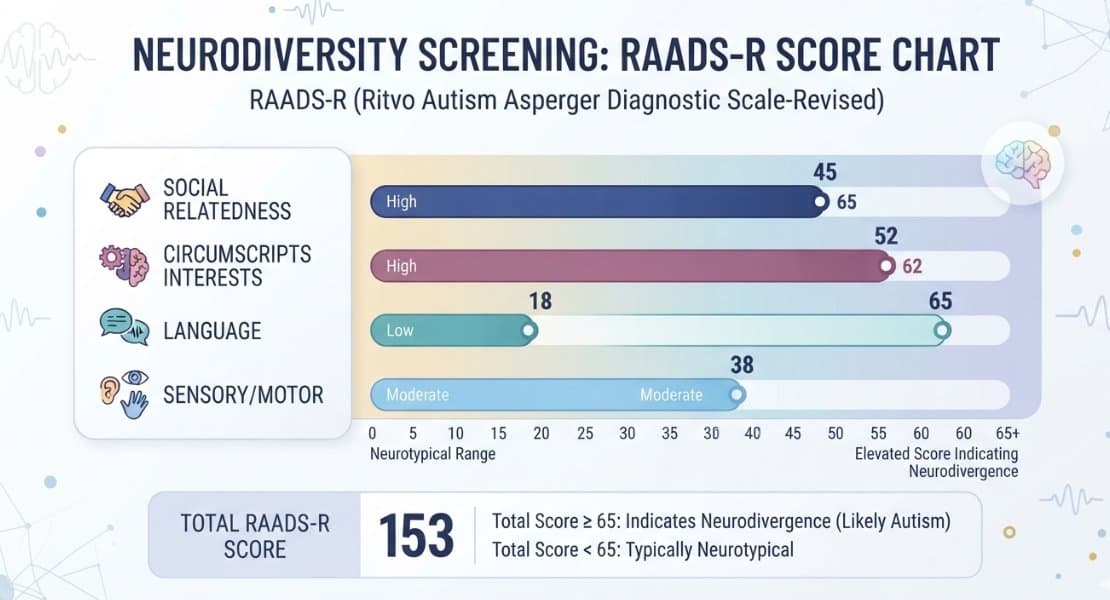
When you sit down to take an adult autism screening questionnaire, you expect clear questions that help you reflect on your life. However, if you have experience with adult screening tools, you likely know that feeling stuck is common. You might experience difficulty understanding RAADS-R questions while staring at a single item, wondering what it actually means. If this happens to you, you are not alone, because many neurodivergent adults find themselves overanalyzing ambiguous phrasing. When you are ready to explore your patterns safely, you can try the RAADS-R online test as an educational tool.
This guide helps you make sense of that confusion. We explore why these questionnaire items often feel frustratingly vague, provide a practical framework for navigating choices, and break down common stumbling blocks like idioms. By the end of this article, you will have a clear mental roadmap to complete your screening with confidence.

One primary reason people face difficulty understanding RAADS-R questions is the clash between literal interpretation and neurotypical language. Traditional clinical tools were often written from a generalized perspective. They use broad social idioms and qualitative words like "normal," "frequent," or "compassionate."
For a literal thinker, these words lack hard definitions. If a question asks if you are a compassionate person, your brain might immediately generate exceptions. Because the statement lacks specific parameters, you freeze. You try to apply a strict logical framework to a question designed with vague social assumptions.
Autistic and neurodivergent minds often operate through monotropism—a tendency to dive deep into specific contexts. When you encounter a broad statement on a screening tool, your brain immediately looks for the missing context.
For example, a prompt about social comfort might make you wonder: Am I comfortable with close friends, or at work, or during sensory overload? Because the question ignores these crucial environmental variables, it feels impossible to answer accurately. If you want a more contextual experience, you can explore our comprehensive RAADS-R guide to better understand how questions map to real-life situations.
The RAADS-R was developed in the mid-2000s. Language around neurodivergence and masking has evolved significantly since then. Some phrases reflect older clinical terminology that no longer resonates with modern adults. Recognizing this helps validate why certain sentences feel awkward or disconnected from your lived reality.

Navigating the four response options is often where test-takers experience the most friction. The questionnaire asks you to evaluate your experiences across two distinct life phases using four specific choices:
Understanding this timeline requires separating your authentic baseline from adaptive strategies. If a trait was present in childhood and remains part of your daily experience, the first option applies. If it emerged recently due to burnout, the second option fits better.
Many adults develop complex coping mechanisms during childhood. You might have forced yourself to make eye contact or suppressed sensory stims to fit in.
When you encounter an item about natural social ease, you might wonder how to score it if you only performed that behavior because you were taught to. As a general guideline, if a behavior required intense conscious effort and anxiety during childhood, it is often a sign of early masking. Focus on your internal exhaustion levels rather than external compliance.
When a prompt feels entirely dependent on context, use this quick three-step mental checklist:
Some questionnaire items rely on idiomatic expressions to gauge social understanding. If you understand metaphors intellectually, you might hesitate. You might ask yourself: I know what this phrase means, but do I experience it naturally?
Remember that these items explore your instinctive social processing, not your vocabulary test score. If an idiom feels artificial or requires translation in your mind, that hesitation is worth noting.
Questions regarding empathy frequently cause distress. Many autistic adults experience intense emotional empathy—feeling others' pain so deeply that it causes physical overwhelm. However, clinical questionnaires often ask simplified questions about whether you care about others.
If you feel immense compassion but struggle to express it outwardly during a crisis, you may feel torn. When answering, prioritize your internal emotional reality over external misunderstandings. Feeling profound empathy privately is entirely compatible with being on the autism spectrum.
The RAADS-R includes statements that sound positive or neurotypical on the surface, serving as reverse-scored items. These catch response bias. If you skim them quickly, you might answer instinctively without realizing the scoring logic. Read each sentence twice, paying attention to words like "rarely" or "never."

When static forms feel rigid and difficult to parse, taking a break to re-frame your approach can help. Moving from frustration to clarity often requires a supportive environment where you can explore your traits without rigid time limits or confusing clinical jargon.
If you want a more streamlined experience, you can explore our RAADS-R online test to unpack complex behaviors at your own pace. While navigating these concepts, remember that exploring your neurodivergent traits should feel empowering, providing a safe space to better understand your unique cognitive wiring without unnecessary pressure.
If you spend twenty minutes dissecting a single sentence, you might worry that your overthinking invalidates your results. However, deep analysis and hyper-focus are characteristic cognitive traits for many neurodivergent individuals. Caring deeply about accuracy and struggling with ambiguous guidelines is often a strong indicator of an analytical mind at work.
It is also important to recognize that screening scores can overlap with other neurodivergent profiles or mental health experiences. Conditions like ADHD, complex trauma, and severe social anxiety can produce executive dysfunction or social challenges that mimic certain autism traits. If your scores fluctuate, consider how overlapping conditions might influence your daily experiences.
Navigating confusing questionnaire items is ultimately an exercise in deep self-awareness. By breaking down your literal thinking, identifying your masking habits, and recognizing your baseline behaviors, you are building a clearer picture of your internal world.
If your self-reflection suggests that neurodivergent traits strongly resonate with your life, consider using your notes as a foundation for future conversations. Bringing specific examples of your daily challenges to a qualified healthcare professional can help you pursue formal guidance and tailored support. You can also review your RAADS-R test results explained in our supplementary guides before speaking with a clinician.
Standardized psychological screening tools use broad normative statements to establish a baseline across populations, whereas neurodivergent minds rely heavily on situational variables.
While overthinking is not a diagnostic criterion on its own, a deep-seated drive to analyze ambiguous phrasing with absolute precision often aligns with autistic cognitive profiles.
If a behavioral prompt describes a situation you have never experienced, select the "Never true" option, or choose the baseline that best reflects your general daily reality.
Yes. High scores can sometimes reflect overlapping neurodivergent profiles or mental health conditions, such as ADHD, sensory processing differences, or complex trauma responses.
Consider whether the behavior is an innate instinct or an exhausting performance. If it required conscious calculation, evaluate how you managed it during childhood versus today.
Not at all. Feeling challenged by vague wording is a widely shared experience among autistic adults, and taking note of your hesitation provides valuable qualitative insight.