//

If you already have an ADHD diagnosis, taking a new screener can feel both exciting and incredibly confusing. Many individuals searching for a reliable raads-r test for adults with adhd find themselves wondering if their traits are shared across both conditions.
This comprehensive guide will help you understand how these overlapping characteristics affect your results and what your final numbers actually mean. Specifically, we will provide a step-by-step overlap checklist, clarify common scoring myths, and show you how to navigate rigid assessment questions. First, you might want to review our comprehensive RAADS-R test guide to ground your self-discovery process in reliable context. By exploring these patterns, you can build a deeper, kinder relationship with your neurodivergent mind.

Many adults are discovering they do not fit into just one neurodivergent box. Instead, they find themselves identifying with both Attention Deficit Hyperactivity Disorder (ADHD) and Autism Spectrum Disorder (ASD). This unique combination is often called AuDHD.
In everyday life, AuDHD can feel like a constant internal tug-of-war. For instance, your ADHD side may crave novelty, chaos, and spontaneous adventures. At the exact same time, your autistic side might require strict routines, predictability, and deep quiet.
Because these two systems operate together, your daily experience becomes highly complex. If you have been searching for a raads-r test for adults with adhd, you are likely trying to make sense of this very overlap. For example, you might meticulously organize a planner to satisfy your autistic traits, only to abandon it a day later because of ADHD executive dysfunction.
To understand your results, you must first explore why autism and ADHD symptoms overlap so frequently. Both conditions are rooted in atypical brain development, which means they affect similar cognitive pathways.
For example, sensory sensitivity is extremely common in both ADHD and autism. Loud noises, bright lights, or scratchy clothing can overwhelm you, regardless of your specific diagnosis. Also, both profiles involve executive dysfunction, which impacts your ability to organize, plan, and start tasks. When you look at a raads-r test autism screener, you will notice many questions touch on these shared difficulties.
Because traits can mask each other, we created this checklist to help you visualize where ADHD and autism meet. This list highlights how symptoms combine to create a distinct lived experience.
By identifying these overlapping habits, you can see why taking a raads-r test for adults with adhd is such a common step for neurodivergent seekers.
When exploring your traits, you might wonder if taking a raads-r test for adults with adhd will automatically lead to a high score. Many people with ADHD indeed score higher on autism screeners than neurotypical individuals do.
If you have ADHD, your cognitive style naturally influences how you interpret specific test prompts. For example, some questions ask if you prefer to do things the same way every time.
An autistic person might answer "yes" due to a deep need for sameness. However, an ADHDer might also answer "yes" because they have developed strict routines to cope with their forgetfulness. This shows how different underlying motivations can lead to the same answer on a raads test adhd assessment. Therefore, your ADHD coping mechanisms can easily elevate your autism score.
Because of these behavioral overlaps, online screening tools can sometimes produce false positives. A false positive occurs when your ADHD traits mimic autistic traits closely enough to trigger a high score.
For instance, difficulty with social cues might stem from autistic differences. On the other hand, it could also result from ADHD inattention during conversations. If you want to reflect on your traits safely, you should check your traits with this RAADS-R test to see your detailed category scores. This approach helps you separate focus issues from social communication preferences.
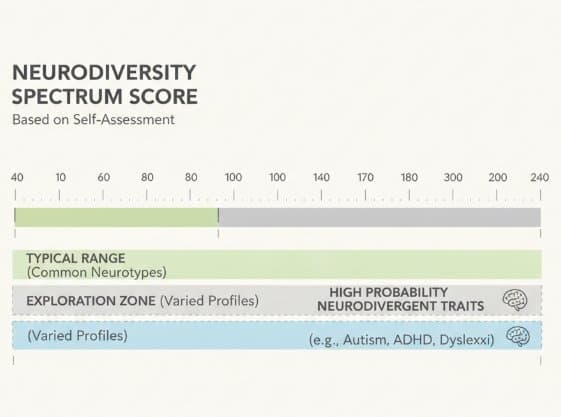
The RAADS-R assessment uses a 0 to 240 scoring range. To analyze your results, you must look at how these points are distributed.
A score of 65 is the standard clinical threshold for autism. If your score is below 65, you likely show very few autistic traits.
However, if you score above 65, it indicates a significant presence of autistic characteristics. Understanding this raads-r test scoring system helps you put your personal numbers into a broader context. For example, a score of 130 strongly suggests autism, whereas lower scores might indicate a mix of other neurodivergent traits.
For adults with ADHD, scoring in the 65 to 105 range is incredibly common. We often call this range the "gray zone" of neurodivergence.
In this zone, your traits are elevated, but they may be driven heavily by your ADHD rather than autism. For instance, your sensory challenges and social fatigue might push your score past the threshold. Therefore, you should not view a score in this range as definitive proof of autism. Instead, look at it as an invitation to explore your traits with more curiosity and less anxiety.
While the RAADS-R is a highly respected screener, it has notable limitations when applied to adults with ADHD.
Many adults find the test questions frustratingly literal. Because researchers designed the test years ago, some prompts rely on outdated stereotypes about autism.
For example, a question might ask if you prefer to associate with animals rather than people. For a neurodivergent adult, this choice is far too simple and ignores your real-world relationships. In contrast, a modern adhd test for adults usually focuses on more relatable, daily behavioral struggles. As a result, you might feel stuck trying to choose between "always" and "never" when your real answer is "it depends."
Social masking is another huge factor that can distort your scores. Masking is the unconscious habit of hiding your neurodivergent traits to blend in with neurotypical society.
If you have masked your traits since childhood, you might answer questions based on your learned behaviors rather than your true feelings. For instance, you might select "I find social situations easy" because you have spent years practicing social scripts. Consequently, this coping mechanism can artificially lower your final score, hiding your true autistic traits.
To help you navigate these rigid options, we have decoded three of the most confusing questions below. This tool helps you look past the literal phrasing to find the true psychological intent.
| Original Question | Why It's Confusing for ADHDers | How to Re-interpret It Mindfully |
|---|---|---|
| "I prefer to do things the same way." | ADHDers hate boredom but need rigid routines to survive daily life. | Focus on whether repetition comforts your mind or just keeps you organized. |
| "I get extremely upset when routines change." | ADHDers are spontaneous but can get dysregulated by sudden transitions. | Ask if the frustration is about losing cognitive control or sensory overwhelm. |
| "I find it hard to understand what others feel." | ADHDers can be hyper-empathetic but miss social cues due to simple distraction. | Consider if you struggle to read subtle, non-verbal facial expressions in real-time. |
By using this decoder, you can answer the raads-r test for adults with adhd with much greater clarity.

When you realize the limitations of standard questions, you might wonder how to get a clearer picture of your mind. Taking a raads-r test for adults with adhd should be an empowering act of self-discovery, not a source of confusion.
A simple score threshold cannot capture the beautiful complexity of your brain. Knowing your score is helpful, but you also need to understand the "why" behind your answers. Therefore, look for tools that offer deep, contextual breakdowns of your neurodivergent patterns rather than basic pass-fail labels.
Because we understand these frustrations, we designed an alternative way to explore your traits. Our AI-assisted screening tool guides you through the classic questions with helpful, gentle context. Instead of leaving you to guess, our system analyzes your unique response patterns to provide a detailed, easy-to-read behavioral report.
If you are ready to explore your neurotype without pressure, you can explore our RAADS-R test online. This educational tool is designed to help you organize your thoughts and find validation at your own pace.
*Medical Disclaimer: Our AI-assisted screening tool is an educational self-reflection resource and is not a clinical diagnosis. It cannot replace a formal evaluation by a medical professional.
Exploring your neurodivergence is a deeply personal process. Ultimately, taking the raads-r test for adults with adhd is just the beginning of a larger path toward self-acceptance.
If your score is high, take a deep breath. A high score is not a clinical diagnosis, and it does not mean anything is wrong with you. Instead, use this information as a tool for self-compassion. It explains why certain environments feel draining and why your mind processes the world uniquely.
You can use your detailed screening results to build a personal narrative of your lived experiences. For instance, you can write down specific examples from your childhood that match your high-scoring traits. If you choose to seek a formal evaluation, this structured list will be incredibly valuable for your doctor. Meanwhile, continue to connect with neurodivergent communities to share experiences and find comfort.
No, an online screener cannot guarantee a diagnosis. While a high score indicates strong autistic traits, conditions like ADHD, sensory processing issues, and anxiety can also elevate your score. Only a qualified clinician can provide a formal clinical diagnosis.
An online screener is a preliminary tool designed for educational self-reflection and personal insight. In contrast, a clinical diagnosis involves comprehensive developmental interviews, observation, and formal testing by a licensed psychologist or psychiatrist.
No, there is no separate cutoff for ADHD. The standard clinical threshold of 65 applies to everyone. However, adults with ADHD frequently score in the 65 to 105 range due to overlapping sensory and social traits.
An adult ADHD test focuses primarily on focus, impulsivity, and executive function. Conversely, the RAADS-R specifically assesses social reciprocity, language differences, sensory sensitivities, and circumscribed interests.
Clinical studies suggest a very high rate of co-occurrence. Approximately 30% to 80