//

You are exploring your neurodivergent traits, but the alphabet soup of online tools can feel overwhelming. When comparing raads-r vs aq-10 vs cat-q, you might wonder which questionnaire actually matches your unique adult experiences. This article helps you cut through the confusion effectively. We will break down exactly what each assessment measures and why finding the right fit matters for your journey. You will discover actionable insights through a step-by-step matcher, a clear comparison checklist, and guidance on how to safely interpret your scores. To help you start,explore our RAADS-R test online to find the best starting point for your personal self-discovery.

Looking at the raads-r vs aq-10 vs cat-q, you probably notice how different they look. This happens because autism is a broad spectrum, not a single straight line. Therefore, psychologists design different tools to capture different experiences.
Historically, autism screening focused primarily on young children. As a result, older assessments looked for obvious outward behaviors. However, the mental health field has evolved significantly. Today, many adults discover their neurodivergence much later in life. Because of this, researchers created new questionnaires tailored specifically for adult experiences. The best autism screening test for adults must look at internal feelings, not just external actions.
Everyone processes the world uniquely. For example, one person might struggle visibly with sensory overload. Meanwhile, another person might hide their social exhaustion perfectly. Therefore, one single test cannot measure everything accurately. This explains why we have multiple options. Some tools provide a rapid overview. In contrast, others dig deeply into your childhood memories. Understanding these differences helps you choose the most validating tool for your situation.
If you feel stuck deciding between the raads-r vs aq-10 vs cat-q, use this actionable step-by-step matcher. This section will guide you instantly to the right starting point based on your current needs.
Do you want a fast, preliminary check? If so, the AQ-10 is your best option.
Do you constantly observe others to learn how to act "normal"? If this sounds familiar, you need the CAT-Q.
Do you want a comprehensive, detailed breakdown of your life experiences? Therefore, the RAADS-R is your ultimate choice.
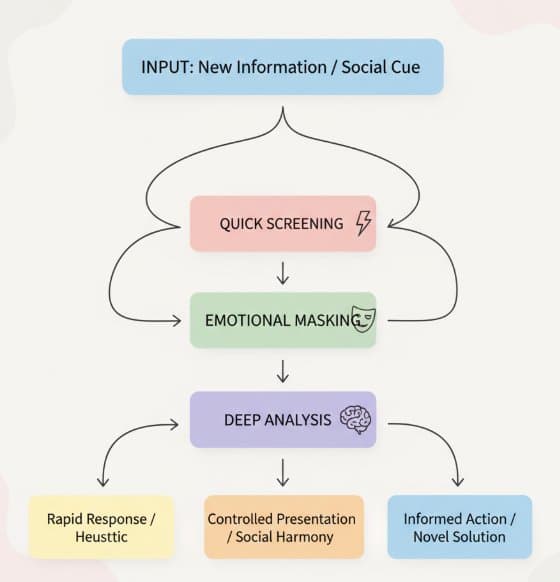
To truly understand the difference between raads-r aq-10 and cat-q, we must look at their specific designs. Each tool serves a distinct psychological purpose.
The Autism-Spectrum Quotient 10 (AQ-10) is a shortened version of a much longer test. Medical professionals often use it during brief appointments. First, it is incredibly fast. You only answer ten simple questions. Second, it focuses on general behaviors like noticing details or preferring routines. However, it is not deeply nuanced. Because it is so brief, it easily misses people who have learned to adapt socially. Thus, it is a starting point, not a final answer.
The Camouflaging Autistic Traits Questionnaire (CAT-Q) is truly unique. This autism masking test cat-q does not actually measure classic autism traits. Instead, it measures how hard you try to hide them. For instance, it asks if you practice your facial expressions in the mirror. Also, it checks if you force yourself to make eye contact. Consequently, this tool is highly validating for late-diagnosed adults. When comparing raads-r vs cat-q for adults, remember that the CAT-Q explicitly focuses on your social survival strategies.
The Ritvo Autism Asperger Diagnostic Scale-Revised (RAADS-R) is a deeply detailed self-report questionnaire. It contains 80 questions. Unlike the other two tools, it asks you to consider your behaviors both now and when you were young. This is crucial because neurodivergent traits often change as we age. Furthermore, it breaks your traits down into specific categories. It covers language, social relatedness, sensory motor skills, and localized interests. Therefore, it provides the most comprehensive picture of your inner world.
When reviewing the raads-r vs aq-10 vs cat-q, you must understand their limitations. Online tools are powerful, but they require careful interpretation.
Masking is a coping mechanism. It happens when you subconsciously suppress your natural behaviors to fit in. Unfortunately, heavy masking can drastically lower your scores on traditional tests. For example, the AQ-10 might ask if you enjoy social chitchat. You might answer "yes" because you learned how to do it successfully. However, you might ignore the massive exhaustion it causes you. As a result, you get a false negative. If you suspect this, you should always review your traits with a more detailed tool. If you want a deep dive, reading a comprehensive RAADS-R test guide can help clarify these nuances.
Many people panic when they see a high score. Please take a deep breath. A high score on these questionnaires does not confirm a medical condition. Instead, it indicates a high probability of neurodivergent traits. It simply means your brain processes information similarly to autistic individuals. Therefore, a high score is an invitation for self-reflection, not a medical label. You should view these results as a helpful map of your personal behavioral patterns.

You might wonder about aq-10 vs raads-r accuracy. Scientifically, both tools are highly valid in research settings. They consistently identify individuals with autistic traits. However, clinical screening tools cannot replace a human doctor. A professional psychiatrist looks at your life history, emotional health, and ruling out other conditions. Self-assessments are educational tools. Consequently, if your traits cause you significant distress or interfere with your daily life, please consult a neurodiversity-affirming therapist or doctor.
You now understand the raads-r vs aq-10 vs cat-q differences. Now that you know this, what is your next step? Moving from research to self-reflection requires a safe, structured approach.
Before taking any questionnaire, follow these simple steps to ensure the best experience:
Most online tests simply give you a final number. For example, they might say, "You scored 140." However, a raw number tells you nothing about how your mind works. It does not explain your unique sensory triggers. Also, it does not offer coping strategies for your specific social burnout. You need context, not just a number.
We believe self-discovery should be insightful and supportive. That is why we upgraded the traditional testing experience. Our platform uses advanced AI to analyze your questionnaire responses gently and privately. Instead of a cold medical score, you receive a nuanced, educational breakdown of your personal traits.
When you use our educational tool, you gain clarity. First, you will see a visual map of your sensory and social patterns. Next, you will understand how your traits connect to your daily stress levels. Finally, you will receive practical, neuro-affirming insights designed for your personal growth.

Navigating the raads-r vs aq-10 vs cat-q does not have to be confusing. The AQ-10 offers a quick glance. Meanwhile, the CAT-Q reveals your hidden masking efforts. Finally, the RAADS-R provides a deeply comprehensive review of your life. Remember, there is no right or wrong way to explore your neurodivergence. These tools exist to validate your experiences, not to put you in a restrictive box.
You deserve to understand your own mind in a safe, judgment-free way. If you are ready to map out your unique behavioral patterns, try the RAADS-R test today. Take this step gently, and remember to always seek professional medical advice if you need clinical support.
How accurate is the RAADS-R test for adults?
The RAADS-R is highly accurate in scientific research for identifying autistic traits in adults. However, it is an educational self-report tool. Therefore, it cannot officially diagnose you without a professional clinical evaluation.
Which autism questionnaire is the most comprehensive?
The RAADS-R is generally considered the most comprehensive. Because it contains 80 questions and asks about both your current life and your childhood, it covers the widest range of lifespan behaviors.
Why might someone score high on the CAT-Q but low on the AQ-10?
This happens frequently to people who mask their traits. The AQ-10 measures visible, outward autistic behaviors. In contrast, the CAT-Q measures your internal effort to hide those behaviors. Thus, a high-masking person will score low on visibility but high on effort.
Can I use the RAADS-R or CAT-Q for an official medical diagnosis?
No, you cannot. These self-assessments are excellent educational tools for self-reflection. However, an official medical diagnosis must be conducted by a qualified healthcare professional, such as a psychiatrist or clinical psychologist.
What should I do if my self-assessment scores are high?
First, do not panic; this simply highlights your unique neurodivergent patterns. You should save your results as a personal reference point. Next, if you seek accommodations or feel overwhelmed, consider sharing these results with a neurodiversity-affirming therapist.