//

Have you spent much of your life feeling fundamentally different from everyone else? Many women grow up assuming they are simply too sensitive, too anxious, or somehow failing at things that seem easy for other people. If that sounds familiar, you may be looking for a checklist of possible signs of undiagnosed autism in women. This guide explains why autistic traits in women can be overlooked, describes common patterns, and offers practical next steps for self-reflection. If you want a structured place to begin, you can use our RAADS-R test online to organize observations about your experiences. The result is educational, not a diagnosis, but it may help you prepare for a more informed conversation with a qualified professional.

Finding a reliable checklist of possible signs of undiagnosed autism in women can be difficult. Autism research and diagnostic models historically included far more boys and men than girls and women. That imbalance helped shape expectations around more visible, stereotypically male presentations. Women whose traits look different may therefore reach adulthood without recognition or appropriate support.
For many years, autism was widely framed as a predominantly male condition. Early research often focused on boys with highly visible or disruptive behaviors, and diagnostic practice developed around those presentations. Autistic women may show different or less externally visible patterns. Rather than acting out, you may have internalized distress or worked hard to compensate for difficulties. Subtle signs in childhood can therefore be missed by teachers, clinicians, and family members.
Girls are often expected to be polite, quiet, and socially accommodating. An autistic girl who finds social situations difficult may learn to imitate peers, rehearse expected behavior, or suppress visible distress. Repeating these strategies over time can turn them into deeply ingrained habits. As a result, traits associated with autism in women may remain hidden behind a carefully maintained social mask.
Social masking is one important reason some autistic women are identified late. Masking means consciously or unconsciously hiding, suppressing, or compensating for neurodivergent traits in order to fit in. It can help someone navigate school, work, or relationships, but maintaining it may require substantial mental and physical effort.
Masking can involve intense effort that other people never see. Maintaining eye contact, for example, may require deliberate concentration. You might plan a routine conversation before ordering coffee or study how other women speak and then copy their tone. These strategies can make social interaction look effortless from the outside even when it feels like sustained performance on the inside.
To understand this better, look at the comparison table below. This checklist compares what others see versus what you actually experience on the inside.
| What Others See (External Perception) | What You Actually Experience (Internal Reality) |
|---|---|
| You maintain great eye contact during meetings. | You feel physical discomfort and count the seconds until you can look away. |
| You seem very social and bubbly at parties. | You rely on a pre-planned script and experience extreme exhaustion afterward. |
| You are a great listener who rarely interrupts. | You are frantically analyzing the other person's facial expressions to guess their mood. |
| You seem completely calm in busy environments. | You are fighting a silent panic attack or dissociating due to sensory overload. |

Long-term masking can contribute to autistic burnout: a period of profound physical, mental, and emotional exhaustion. During burnout, everyday tasks may become much harder and sensory sensitivities may intensify. Experiences vary, and burnout is not itself a formal medical diagnosis, but many autistic people use the term to describe a meaningful pattern in their lives.
If you think you may be neurodivergent, a checklist of common signs can help you organize experiences you may want to explore further. Autism is a spectrum, and no single list can determine whether someone is autistic. You do not need to identify with every item, and many of these experiences can also occur for other reasons. The patterns below describe how autistic traits may appear in some adult women.
Socializing can feel like playing a complex game whose unwritten rules everyone else seems to know. Autistic women, including those with lower support needs, may rely on conscious analysis rather than intuition to navigate social interactions.
Sensory differences are common in autism, although their form and intensity vary from person to person. Some nervous systems become overwhelmed when they receive too much information at once.
Stimming (self-stimulatory behavior) can help a person regulate attention, emotion, or sensory input. Although media depictions often focus on hand-flapping, some women use forms of stimming that are less visible.
Autistic people may develop deep, sustained interests. In women, these interests can involve socially common subjects, which may make their intensity or regulatory role less noticeable.
Executive-function differences can affect planning, starting, switching, and completing tasks. These difficulties can occur in autism, ADHD, and other conditions, so they should be considered as part of a broader pattern rather than as proof of autism on their own.
Reading through an undiagnosed autism in women symptoms checklist can bring up many mixed emotions. You might feel a sense of profound relief, quickly followed by confusion about what to do next. Fortunately, you do not have to figure this out alone.
First, take a breath and notice your reaction without judging it. If many of the patterns above feel familiar, write down specific examples and consider how long they have been present and how they affect daily life. Recognizing recurring experiences can be a useful step toward self-understanding.
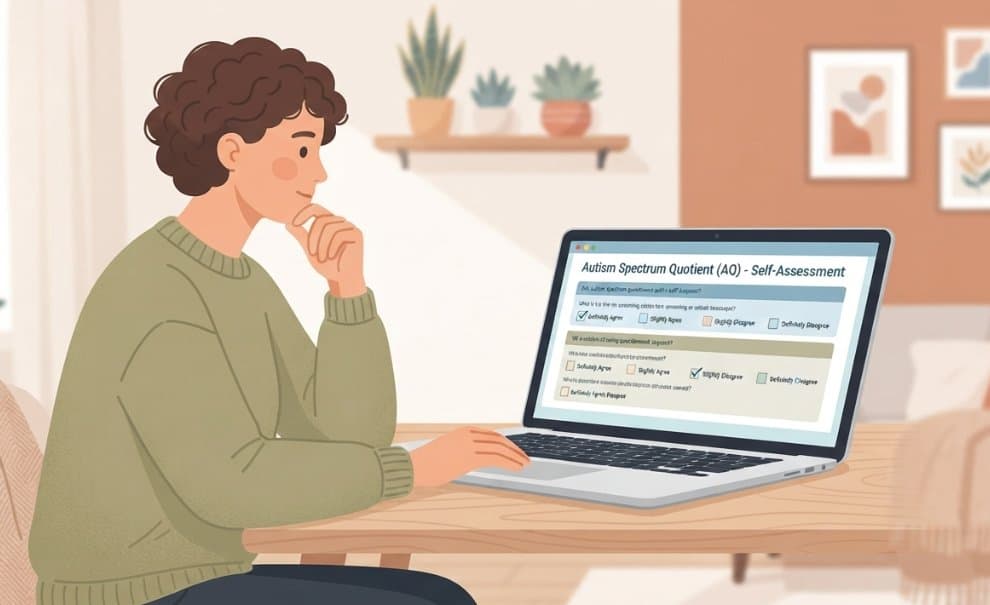
If you want to explore these patterns further, a structured self-report questionnaire may help you organize your observations. You can review your traits with this RAADS-R test in a low-pressure setting. A score does not show how likely you are to be autistic and cannot confirm or rule out autism; overlapping conditions and the way questions are interpreted can also affect results.
Educational screening tools are for reflection and discussion, not medical diagnosis. A report may summarize how you answered different groups of questions, but it should not be treated as a clinical conclusion. You can use it alongside notes about childhood and current experiences, or share it with a qualified clinician as one small part of a broader assessment.
When adult women seek professional help, they may first receive diagnoses that address anxiety, depression, ADHD, trauma, or other difficulties. Those diagnoses may be accurate, incomplete, or occasionally mistaken; a careful assessment should consider both co-occurring conditions and possible underlying neurodevelopmental differences.
Anxiety and depression are common among autistic adults, but they are not universal and should not automatically be treated as evidence of autism. Sensory overload, chronic masking, and social exclusion can contribute to distress for some people. Psychological therapies can still be helpful when they are adapted to the person's communication style, sensory needs, and preference for concrete, structured approaches.
Autism and ADHD can occur together, a combination often called “AuDHD” in the community. You might prefer predictable routines while also seeking novelty or struggling to sustain attention. If those patterns cause difficulty, a clinician can help distinguish overlapping traits and identify appropriate forms of support.
Recognizing possible autistic traits can open the door to greater self-compassion. You can experiment with reducing unnecessary masking in safe settings, respecting sensory needs, planning recovery time, and setting clearer boundaries. These changes can be useful whether or not you later pursue a formal assessment.
Self-identification can be a meaningful personal starting point and a way to find relevant language or peer support. It is not the same as a formal diagnosis. Requirements for workplace or educational accommodations vary by location and institution, so consult a qualified healthcare professional or the relevant local service if you need documentation or specialized support. To understand how the questionnaire is scored, see our comprehensive RAADS-R test guide.
You are not broken. Your experiences deserve to be understood with accuracy, context, and compassion.
Can a woman reach adulthood without knowing she is on the autism spectrum? Yes. Some women are not identified as autistic until their 30s, 40s, 60s, or later. Masking, less stereotypical presentations, limited access to assessment, and co-occurring conditions can all contribute to delayed recognition.
What is the difference between self-identification and a formal medical diagnosis? Self-identification is a personal framework for understanding your experiences and connecting with supportive communities. A formal diagnosis is based on a comprehensive clinical assessment by appropriately qualified professionals under local rules. It may be needed for some services or accommodations, but requirements vary by country, school, employer, and support system.
Can an online screening tool replace a clinical evaluation? No. An online screening result cannot diagnose autism or replace a comprehensive clinical evaluation. It can help you record patterns or prepare questions, but the score should not be interpreted as the probability that you are autistic.
How do I prepare for a professional evaluation if I suspect I am autistic? Keep notes about specific experiences in childhood and adult life, including social communication, sensory responses, routines, interests, and the effect of masking. If you complete an educational questionnaire such as the RAADS-R, you may bring the report as supporting context, while making clear that it is not diagnostic.
Why do many autistic women feel a need to mask their natural traits? Masking can develop as a protective response to criticism, bullying, exclusion, or pressure to meet social expectations. Some autistic women learn to suppress natural behaviors or imitate others to reduce those risks. The extent and reasons for masking differ from person to person.