//

Seeing a high number on a neurodivergence questionnaire can feel overwhelming. If you recently received an unexpectedly high result, you might be dealing with a false positive raads-r score. While taking a screening questionnaire is a meaningful first step toward self-discovery, high scores do not automatically mean you are autistic. Many adults discover that anxiety, ADHD, or life stress can inflate their results. In this guide, we will break down what your score actually means and explore why false positives happen in self-assessments. You will also get a practical 4-step checklist to help you reflect on your traits. If you want to review your traits with clearer context, you can explore our RAADS-R test online as an educational self-reflection resource.
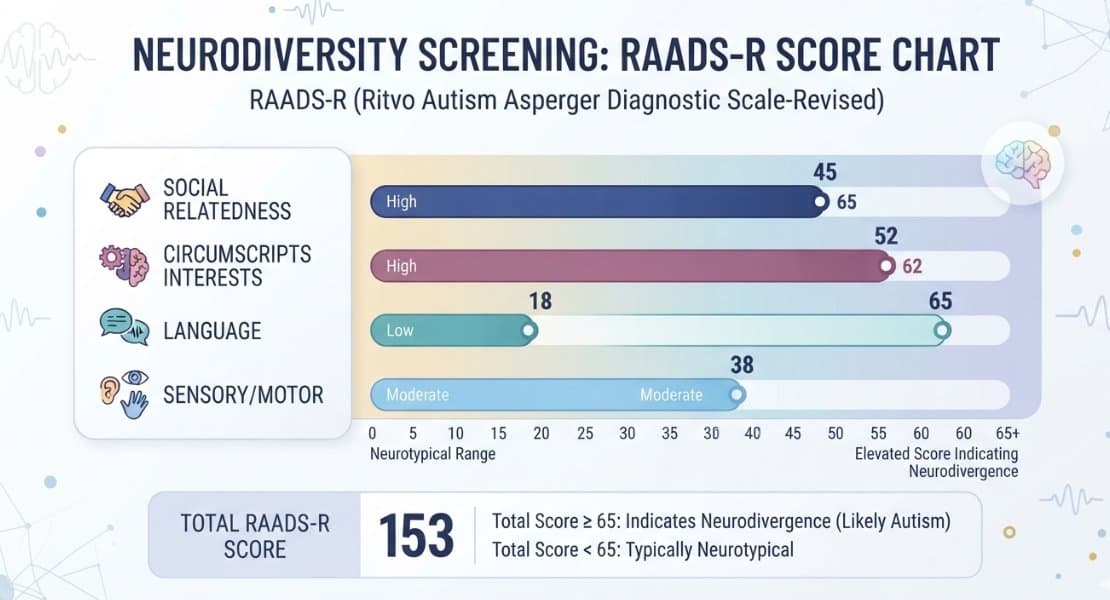
The Ritvo Autism Asperger Diagnostic Scale-Revised (RAADS-R) is an 80-item self-report questionnaire. Clinicians originally designed it to assist in identifying autistic adults who may have gone undiagnosed during childhood. However, understanding your raads-r test score meaning requires looking beyond a single total number. The questionnaire uses a Likert scale ranging from 0 to 3 points per question. Total scores can range from 0 all the way to 240 points.
The benchmark for the RAADS-R is the 65-point cutoff threshold. If your score equals or exceeds 65, the test considers you "positive" for autistic traits. However, this cutoff is merely a screening threshold, not a diagnostic boundary. A screening tool is designed to cast a wide net. Because it prioritizes catching potential traits, it frequently flags non-autistic individuals who experience other psychological differences.
To understand your results better, you must examine a raads-r score chart across its four distinct subscales:
Looking at raads-r subscale scores provides vital context for your total result. For example, if you score extremely high in Sensory-Motor items but low in Social Relatedness, your high total might reflect sensory processing sensitivity rather than autism. Examining subscale distributions helps you pinpoint which specific traits drove your total score above the 65-point threshold.
Experiencing a false positive raads-r score is far more common than many people realize. Self-administered questionnaires rely entirely on personal interpretation without a clinician present to clarify ambiguous wording. As a result, several psychological and structural factors can artificially inflate your total score.
Many questions on the RAADS-R use absolute language, such as "always" or "never." When answering independently, adults often interpret these statements literally or apply them to extreme past memories. Additionally, confusing phrasing on reverse-scored questions can lead people to select options that do not accurately reflect their lifelong behavior.
In psychometrics, sensitivity refers to catching true cases, while specificity refers to correctly identifying non-cases. The RAADS-R was designed with exceptionally high sensitivity. Consequently, its specificity in unsupervised online environments is relatively low. Without professional guidance, the test frequently flags general introversion or social discomfort as autistic traits.
Your immediate emotional state influences how you perceive your past. If you complete the questionnaire during a period of severe occupational burnout or chronic stress, you are more likely to view your social fatigue as a permanent trait. Meanwhile, individuals who experience intense psychological masking may struggle to distinguish between genuine preferences and learned coping strategies.
Autism shares overlapping behavioral traits with numerous other conditions. For instance, difficulty making eye contact or feeling exhausted after parties can stem from social anxiety disorder just as easily as autism. When overlapping conditions bundle together, they frequently push your score over the 65-point threshold.
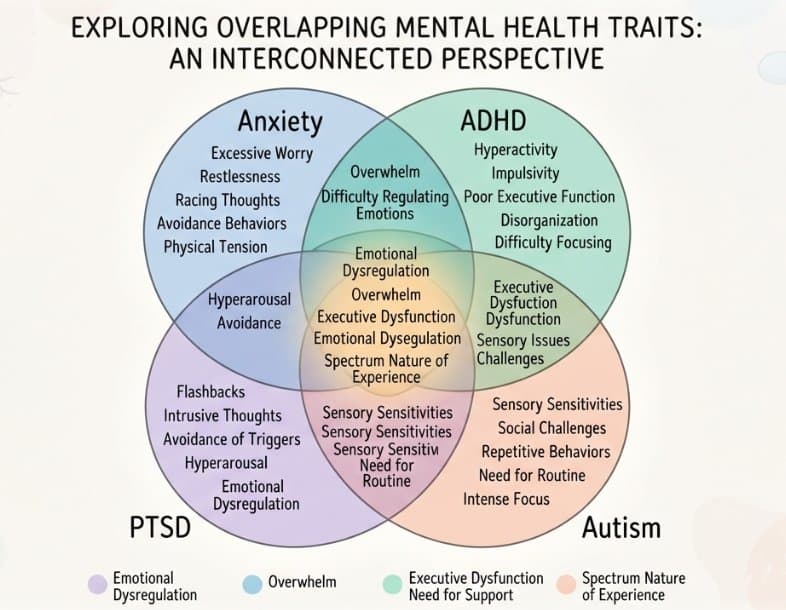
| Feature / Trait | Autistic Expression | Social Anxiety Expression | ADHD Expression | PTSD / Trauma Expression |
|---|---|---|---|---|
| Social Avoidance | Prefers solitude due to social processing fatigue. | Avoids interactions due to fear of negative judgment. | Avoids long conversations due to difficulty sustaining focus. | Avoids crowds due to feeling unsafe or hypervigilant. |
| Sensory Sensitivity | Neurological processing difference present since childhood. | Sensory overload triggered by heightened emotional arousal. | Sensory distraction due to poor attentional filtering. | Sensory triggers tied to past traumatic memories. |
| Special Interests | Deep, highly focused passions driven by intrinsic joy. | Minimal impact, though interests may serve as a distraction. | Intense hyperfixations that shift rapidly over time. | Avoids external hobbies due to emotional numbness. |
| Routine & Sameness | Need for predictability to regulate nervous system. | Craves routine to manage fear of unpredictable anxiety. | Struggles to maintain routine despite wanting order. | Uses strict routine to maintain a sense of control and safety. |
When evaluating raads-r test validity, it helps to look at peer-reviewed research. Initial validation studies published in 2011 claimed near-perfect accuracy for the instrument. However, modern independent replication studies tell a more nuanced story about real-world performance.
Early studies evaluated the RAADS-R by comparing formally diagnosed autistic individuals against non-clinical controls who had no psychiatric conditions. In that artificial environment, the test performed well. In contrast, recent studies testing real-world outpatient populations show a significant drop in specificity. When non-autistic patients with anxiety, depression, or personality differences take the test, a large percentage score above the 65-point cutoff.
Questions about whether the raads-r test is accurate often come down to administration format. In a clinical setting, a trained diagnostic professional guides you through the questions. They clarify ambiguous phrases, ask for real-life examples, and ensure you do not confuse temporary symptoms with lifelong developmental traits. Without that clinical oversight, self-administered tests are far more prone to false-positive outcomes.
To evaluate whether you received a false positive raads-r score, it is essential to examine how other neurodivergent profiles mimic autistic characteristics on self-report items.
Social anxiety and autism look similar from the outside, but their internal motivations differ significantly. If you have social anxiety, you likely understand social nuances instinctively, but fear of embarrassment creates physical distress. In contrast, autistic individuals usually struggle with intuitive social reciprocity or non-verbal cues regardless of anxiety levels.
ADHD hyperfocus is often mistaken for autistic special interests on the RAADS-R. However, ADHD hyperfixations tend to be intense, novel, and short-lived. Autistic special interests usually endure for years and form a core part of an individual's identity and daily regulation.
Trauma and PTSD can leave your nervous system in a constant state of fight-or-flight. This hypervigilance can make light, noise, or crowded places feel unbearable. While this mimics autistic sensory sensitivity on a questionnaire, trauma-related sensitivities usually develop after specific events rather than being present from early childhood.
If you suspect your screening result was influenced by external factors, use this structured checklist to audit your answers. Taking time for mindful self-reflection provides much-needed perspective.

Understanding your traits should not be a confusing or stressful process. Traditional static questionnaires often leave adults feeling stranded with a single number and no context.
Static PDF tests or simple online forms cannot explain what a question actually means. When you encounter a vague phrase like "I talk to people in a literal way," you are left to guess its context. This ambiguity is one of the primary drivers of an accidental false positive raads-r score.
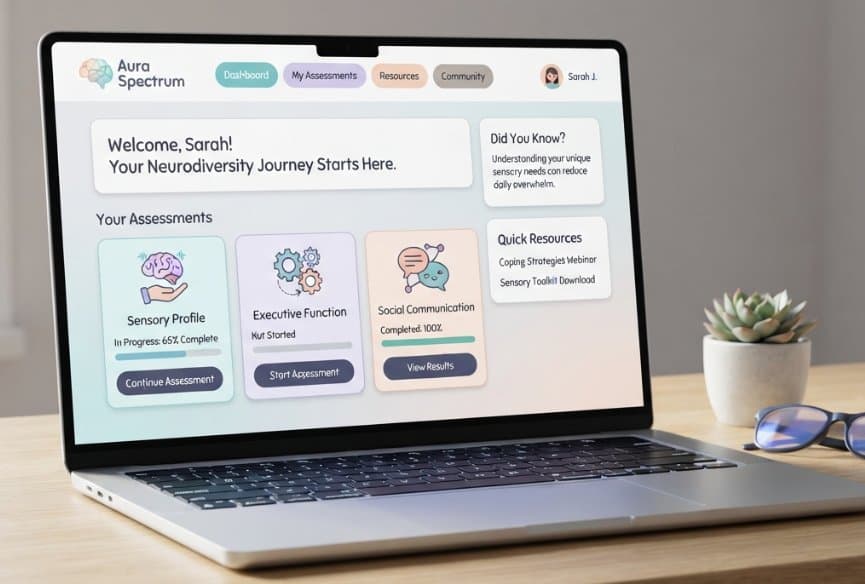
To solve this problem, our platform offers an interactive self-reflection experience. When you check your traits with this RAADS-R test online, you gain access to an intelligent assistant designed to clarify question intent. The tool provides clear breakdowns of each subscale so you can explore your behavioral patterns with confidence.
Instead of delivering a stark, confusing score, our platform generates a detailed trait analysis. You will see exactly how your responses distribute across social, sensory, and language categories. Remember, this tool is strictly an educational resource for personal insight and self-discovery. It does not provide medical diagnoses or clinical judgments.
Receiving a high score on a self-assessment is an invitation for gentle self-exploration, not a definitive medical conclusion. If your results raised questions about your neurodivergent profile, treat yourself with patience and curiosity.
Take time to review your traits, talk with trusted friends, and explore our comprehensive RAADS-R test guide to deepen your understanding. If your traits create significant ongoing challenges in your work, relationships, or mental health, consider scheduling an evaluation with a licensed clinical psychologist or adult neurodiversity specialist. A qualified professional can provide the comprehensive, personalized care you deserve.
A false positive score occurs when an individual scores above the 65-point cutoff on the RAADS-R due to traits like anxiety, trauma, or ADHD, despite not meeting the clinical diagnostic criteria for autism spectrum condition.
No, a high RAADS-R score is not proof of autism. The RAADS-R is an informal self-screening tool designed to flag potential traits. Only a comprehensive evaluation by a licensed healthcare professional can provide an official diagnosis.
Recent independent studies show that while the RAADS-R catches most autistic individuals, its specificity in real-world outpatient settings is relatively low. This means non-autistic adults with anxiety, depression, or PTSD frequently score above the cutoff.
Self-reporting bias occurs when current stress, mood disorders, or misinterpretations of vague test questions lead individuals to over-report social difficulties or retroactively misremember childhood behaviors, inflating their total score.
Yes, you can score high on the sensory subscale without being autistic. Sensory sensitivities are common in conditions like ADHD, Post-Traumatic Stress Disorder (PTSD), Sensory Processing Disorder (SPD), and severe anxiety.
RAADS-R questions use absolute terms like "always" or "never" and were originally phrased for clinical administration. Without a practitioner to clarify context, adults taking the test independently often interpret items too broadly.
If you suspect a false positive raads-r score, complete a self-reflection checklist to audit your answers for stress or anxiety bias. You can also re-evaluate your traits using an AI-guided educational tool and share your findings with a neurodiversity specialist.