//

For many women, the realization that they might be neurodivergent doesn't arrive as a clinical report in childhood. Instead, it often comes as a quiet whisper in adulthood after years of feeling slightly "off-sync" with the world. You might have mastered the art of blending in, yet you find yourself exhausted by simple social interactions. This guide explores the RAADS-R test for females, a specialized tool designed to identify these hidden patterns. We will dive into why autism is frequently overlooked in women and how you can check your traits with this RAADS-R test to begin your journey of self-discovery. This article provides a clear checklist of signs, an explanation of the science, and a detailed guide to interpreting your results.
Historically, the medical world viewed autism through a lens primarily focused on young boys. Consequently, the criteria for identification often emphasized external behaviors like loud outbursts or highly specific interests in machinery. However, we now understand that female autism presentation is frequently more internal and nuanced. Many women develop high levels of social intuition as a survival mechanism, allowing them to pass as neurotypical while struggling immensely behind the scenes.
If you are wondering, "Is it harder to detect autism in females?" the answer is a resounding yes. Research indicates that women are often diagnosed much later in life, if at all. This delay occurs because girls are often socialized to be "polite" and "socially aware," which can mask their underlying struggles. Instead of being identified as autistic, these women are frequently misdiagnosed with anxiety, depression, or borderline personality disorder. Understanding these gender-specific differences is the first step toward reclaiming your identity and finding the support you deserve.
Social masking is perhaps the most significant barrier to identification for women. Masking involves consciously or unconsciously mimicking neurotypical behaviors to fit in. You might have a "script" for small talk or force yourself to maintain eye contact even when it feels physically painful. While this helps you navigate the workplace or family gatherings, it comes at a staggering metabolic cost. Many women experience "autistic burnout"—a state of total physical and mental exhaustion—because they have spent decades pretending to be someone they are not.
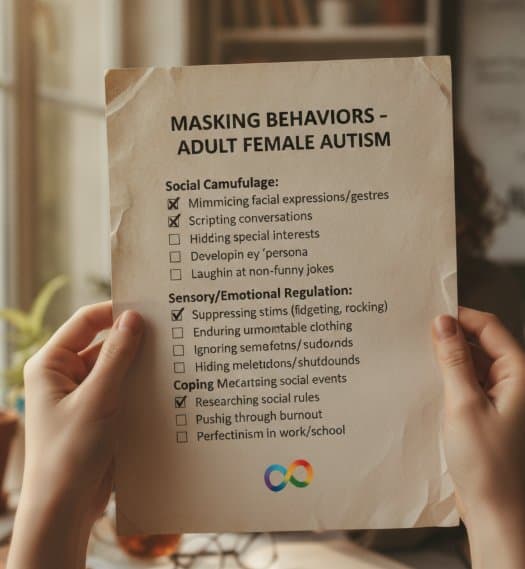
Before diving into the technical details of the RAADS-R test for females, it helps to look at how these traits manifest in your daily life. Masking isn't just about being shy; it is a complex layering of learned behaviors. Use this checklist to reflect on your own experiences:
If these points resonate with you, you are not alone. These are common patterns among neurodivergent women who have spent years compensating for their differences. Recognizing these signs is an essential prerequisite for understanding your screening results.
The Ritvo Autism Asperger Diagnostic Scale-Revised (RAADS-R) is unique among screening tools. While many tests were designed for children, the RAADS-R was specifically built for adults with average or above-average intelligence who may have missed a diagnosis earlier in life. For women who have become experts at masking, this test is particularly powerful because it focuses on internal experiences rather than just visible behaviors.
When discussing raads-r validity, clinical studies often highlight its high sensitivity. In a notable study published on NCBI, the RAADS-R demonstrated a strong ability to distinguish between autistic and neurotypical adults. It covers four key areas: social relatedness, circumscribed interests, language, and sensory-motor symptoms. By examining these diverse domains, the test bypasses your external "mask" and taps into the underlying neurological patterns that define your experience of the world.
One of the most distinctive features of the RAADS-R is its focus on behaviors before the age of 16. Because autism is a neurodevelopmental condition, the traits must have been present during your early development. Many women find this part of the test incredibly validating. It allows them to reconnect with the "little girl" who felt out of place before she learned how to hide her traits. This comprehensive RAADS-R test guide can help you navigate these childhood questions with more clarity.
A common question among our readers is whether the RAADS-R truly effective for the female phenotype. While no self-report tool is 100% accurate, the RAADS-R is considered one of the most reliable options available today. Because it was designed to identify individuals who do not fit the "classic" childhood stereotype of autism, it is inherently better at catching the subtle traits often found in women.
However, it is important to remember that the RAADS-R test for females is a screening tool, not a diagnostic one. It is designed to flag the presence of traits that may warrant further exploration with a professional. Its value lies in providing you with a vocabulary to describe your experiences and a standardized score that you can take to a clinician if you choose to pursue a formal assessment.
If you have spent your life wondering why the world feels louder, brighter, and more confusing than it seems to be for others, you deserve answers. The transition from "wondering" to "knowing" is a profound shift. It allows you to move away from self-criticism and toward self-compassion. Instead of asking "What is wrong with me?", you can begin to ask "What do I need to thrive?".
Our platform offers an AI-enhanced version of the RAADS-R designed to provide deeper insights into your results. Rather than just giving you a single number, our report breaks down your responses into meaningful patterns. This helps you understand not just if you have autistic traits, but how those traits impact your specific life.
When you complete the assessment, you will receive a detailed breakdown. We believe that privacy and clarity are paramount. Our tool is designed to be a gentle, educational resource that empowers you with knowledge. You won’t just see a score; you will see a reflection of your unique neurodivergent profile. This is about more than just a label; it is about finding the keys to your own well-being.
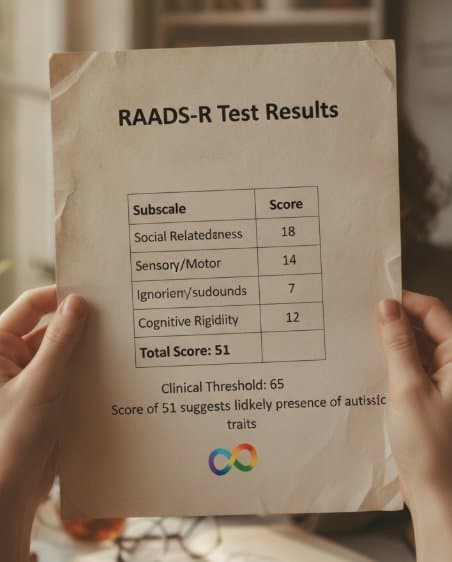
Once you finish the RAADS-R test for females, you will receive a total score. This number can feel overwhelming at first, but it is simply a data point in your broader story. Understanding the context of these numbers is crucial for your peace of mind.
The RAADS-R uses a threshold of 65. If your score is 65 or higher, it indicates that you possess a significant number of traits associated with the autism spectrum. It is important to note that many neurotypical individuals score between 0 and 25. If you land above the 65 mark, it is a strong signal that your brain processes information in a way that aligns with neurodivergence.
Scores in the 130 to 160+ range are quite common among autistic women who have high sensory sensitivities and social challenges. A high score doesn't mean you are "more autistic" in a clinical sense; rather, it indicates a higher density of traits across the four measured domains. If you receive a high score, take a deep breath. This is not a diagnosis of a disease; it is a confirmation that your lifelong feelings of being "different" have a biological and psychological basis.
Completing the RAADS-R test for females is often a major emotional milestone. You might feel a mix of relief, grief, and clarity. Meanwhile, you may wonder what to do next. The first step is to allow yourself time to process this information. There is no rush to "fix" anything because neurodivergence is not something that needs fixing—it is a way of being.
If your results show a high likelihood of autistic traits, consider these steps:
Remember, this journey is yours. Whether you choose to seek a formal diagnosis or embrace self-identification, the goal is to build a life that respects your sensory needs and honors your authentic self.
No, the RAADS-R is a screening tool. While it is highly reliable for identifying traits, only a qualified healthcare professional, such as a psychologist or psychiatrist, can provide a formal medical diagnosis. You can, however, share your report with them to assist in their evaluation.
Social relatedness refers to how you navigate interpersonal connections and empathy. Sensory sensitivity measures your reaction to lights, sounds, and textures. If one is higher than the other, it simply means your autistic traits are more pronounced in that specific area of your life.
Yes, ADHD and autism often co-occur (sometimes called "AuDHD"). Many people find they have traits of both. If you score high on the RAADS-R but also struggle with focus and impulsivity, it is possible you are navigating both neurodivergent patterns.
If you score, for example, a 60, but you strongly identify with the female autistic experience, don't dismiss your feelings. The threshold is a guideline. Factors like current mood or how you interpreted the questions can influence the score. Trust your lived experience.
The questions in the RAADS-R are the same for everyone, but the way women interpret and answer them often differs due to social masking. Our AI-enhanced reporting takes these nuances into account to help provide a more gender-aware perspective on your results.