//

Understanding the autism raads-r threshold is a vital step for many adults exploring their neurodiversity. If you have recently discovered this screening tool, you likely want to know what the numbers mean for your life. This guide will help you navigate the 65-point cutoff and explain how to read your specific results with clarity. We will break down the science behind the scoring system and explore why certain traits carry more weight than others. You will find a detailed score chart, a checklist for professional advocacy, and answers to common misconceptions about accuracy. Our goal is to provide a complete roadmap for those who want to use autism-raadsr.com to gain deeper self-insight.
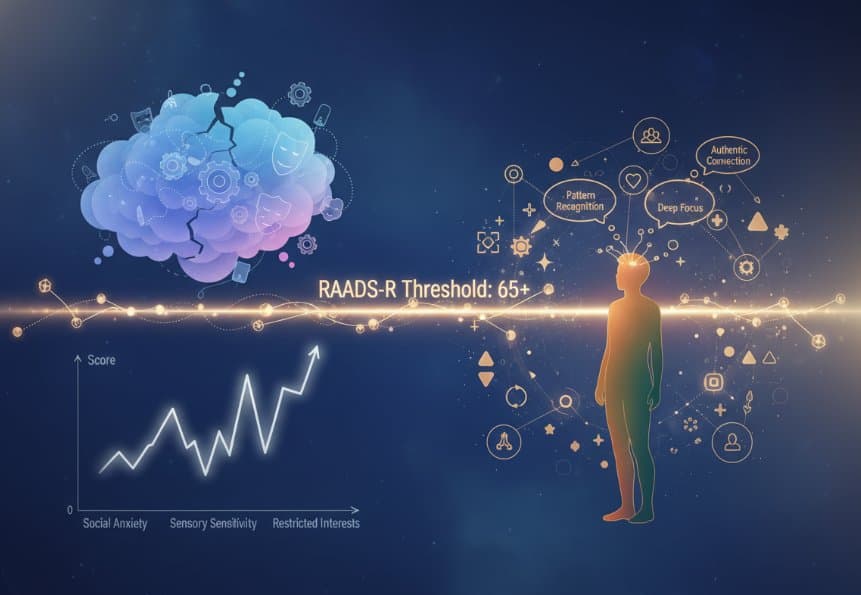
The autism raads-r threshold refers to the clinical cutoff point used to distinguish neurotypical individuals from those with autistic traits. Researchers designed the Ritvo Autism Asperger Diagnostic Scale-Revised specifically for adults who may have been overlooked in childhood. Because many adults develop "masking" strategies to navigate a neurotypical world, traditional tests often fail to identify their underlying patterns.
The primary RAADS-R scoring key identifies 65 as the critical number. If your total score reaches or exceeds 65, it suggests that your reported experiences align significantly with the autistic population. However, this threshold acts as a screening door rather than a final destination. In clinical studies, neurotypical adults almost never score above 65. Meanwhile, the vast majority of autistic adults score significantly higher. This makes the threshold a highly sensitive indicator for those seeking to understand their internal landscape.
Furthermore, the threshold represents the point where social, sensory, and cognitive differences become statistically relevant. It does not mean that a score of 64 indicates a lack of neurodiversity. Instead, it suggests that the specific traits measured by this scale are less prominent in your daily life. Most professionals view the 65-point mark as the "baseline of evidence" required to justify further clinical investigation.
When you receive your results, the raw number can feel abstract. To make sense of your data, you should look at a RAADS-R test score chart to see where you land on the spectrum of evidence. The scale ranges from 0 to 240, providing a wide area for nuance. Most people find that their scores fall into one of four distinct categories.
| Score Range | Evidence Level | Clinical Interpretation |
|---|---|---|
| 0 – 64 | Negligible Evidence | You likely do not have significant autistic traits. |
| 65 – 120 | Elevated Evidence | You show clear signs of autistic traits (Likely ASD). |
| 121 – 160 | Strong Evidence | Your traits align closely with the autistic population. |
| 161 – 240 | Very Strong Evidence | You demonstrate very significant autistic characteristics. |
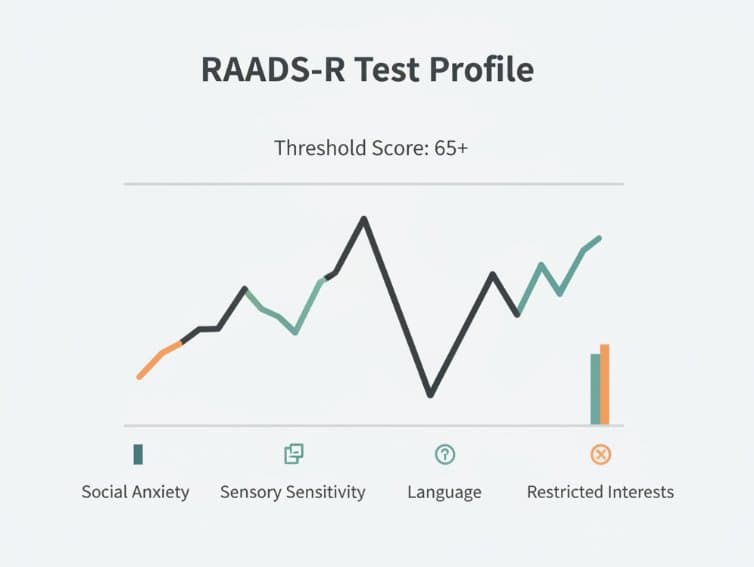
A score in the 65–120 range often reflects the "hidden" nature of adult autism. If you are in this bracket, you might have spent years wondering why social interactions feel draining or why certain sounds feel physically painful. Conversely, scores above 160 often indicate that these traits are impossible to ignore. For these individuals, reaching the threshold confirms a lifelong feeling of being "on a different wavelength" than their peers.
Moreover, remember that these ranges are benchmarks for self-reflection. Even if you score highly, your personal experience remains the most important factor. Therefore, use the score chart as a mirror to reflect on your history. If you see a high number, consider how it explains your childhood memories, your sensory preferences, and your unique way of processing the world.
The total score is only one part of the story. To truly understand your neurodivergent profile, you must examine the sub-scales. The RAADS-R social relatedness score is often the most revealing for adults. This section measures how you perceive social cues, manage eye contact, and feel in group settings. Many neurodivergent adults score high here even if they have "learned" to act neurotypical through years of observation.
The other three domains provide context to your social experiences:
When you analyze your RAADS-R social relatedness score, you might find it is disproportionately high. This is common. Some individuals are highly social but struggle immensely with sensory processing. Others might have excellent motor control but find small talk completely baffling. The threshold is reached by the sum of these parts, meaning your unique "shape" of autism is what matters most.
By looking at these sub-scores, you can identify which areas of your life require the most self-compassion. For example, if your sensory score is high, you might realize that your "irritability" is actually sensory overload. This level of detail is why many choose to visit autism-raadsr.com to better understand the nuances of their reported traits.
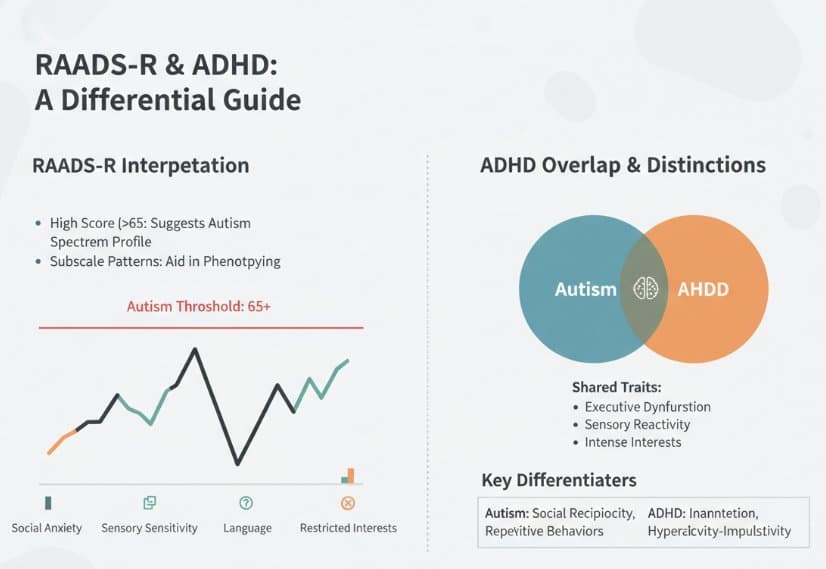
A common question regarding RAADS-R score interpretation is whether other conditions can inflate the results. Because the RAADS-R relies on self-reporting, your current mental state can influence how you answer. Conditions such as Social Anxiety Disorder, PTSD, and ADHD often share overlapping traits with autism. For instance, a person with severe social anxiety might score high on social relatedness questions, but for different underlying reasons.
However, the autism raads-r test was evaluated against other clinical groups during its development. The researchers found that the scale was remarkably good at distinguishing autism from other psychiatric conditions. While an anxious person might fear social judgment, an autistic person often experiences social confusion. The interpretation process tries to tease out these subtle differences.
To ensure your results are as accurate as possible, consider these three factors:
If your result is above the clinical threshold, you might feel a mix of relief and uncertainty. The next step is often deciding whether to seek a formal clinical diagnosis. While a self-test is an incredible tool for self-discovery, a professional can provide external validation. When you prepare to speak with a doctor, having your data organized is essential.
Follow this checklist to prepare for a professional consultation:
Clinicians often appreciate when patients bring screening results because it provides a baseline for discussion. Instead of starting from zero, you are starting with evidence. Explain that you reached the autism raads-r threshold and want to explore what that means for your mental health. This proactive approach helps the professional understand that you have observed your own internal patterns.
If you are not ready for a doctor yet, that is perfectly okay too. Many people use their score simply to find community. Knowing you are above the threshold allows you to seek out neurodivergent spaces where your experiences are the norm. For many, this sense of belonging is the most important outcome of exploring your identity.
No. While 65 is the primary cutoff, your life context matters more. A score of 60 with significant struggles is just as valid for self-exploration as a score of 70.
Autism is a spectrum. You can be autistic and have few sensory issues. The RAADS-R social relatedness score is a heavy contributor for adults, but every profile is different.
A score of 75 is just above the clinical threshold. It suggests you have significant autistic traits and is a clear indicator to move forward with a formal assessment.
A doctor uses it as a "screening result" to decide if a full evaluation is needed. It is a vital piece of the clinical puzzle but not a stand-alone medical diagnosis.
Yes. The RAADS-R focuses on internal experiences rather than just external behaviors. This makes it effective for those who have learned to "mask" their traits.
Reaching the clinical threshold is often a life-changing moment of clarity. For decades, you may have felt like you were reading from a different script. This score is not a label of "brokenness," but rather a map of how your beautiful brain processes the world. Whether you seek a formal diagnosis or use this for self-growth, you now have a foundation of evidence to support your journey.
Remember that a number on a scale cannot capture your entire humanity. However, it can help you find the language to explain your needs. If you are ready to take the next step, you can autism-raadsr.com to check your traits. By understanding your patterns, you empower yourself to build a life that truly fits who you are. Embrace the insights of the autism raads-r experience and move forward with compassion.