//

Finding out your results after an assessment can feel like opening a door to a room you have lived in forever but never truly seen. If you are staring at a number and wondering what is a high RAADS-R score, you are not alone in your curiosity. Many adults seek clarity when their results land significantly above the typical threshold. This guide aims to decode those numbers, explain the subscales, and help you navigate the complex emotions that follow. We will provide a clear breakdown of the scoring range, discuss common benchmarks like 113 or 145, and offer a checklist to help you reflect on your unique neurodivergent profile.
Before diving deep into the data, you might want to try the RAADS-R test online to see where your current traits sit within this framework. Understanding your baseline is the first step toward self-discovery.

To understand what is a high RAADS-R score, we must first look at the design of the test itself. The Ritvo Autism Asperger Diagnostic Scale-Revised (RAADS-R) is an 80-question tool developed specifically for adults. Unlike childhood assessments, it focuses on how you experience the world today versus how you felt before age 16. The total possible score ranges from 0 to 240. However, the most critical number to remember is 65.
The score of 65 is widely considered the "critical threshold" or cutoff. Research suggests that neurotypical individuals rarely score above this number. If your result is 65 or higher, it indicates that you possess a significant number of traits associated with the autism spectrum. However, crossing this line is just the beginning of the story. A score of 66 and a score of 160 both sit "above the cutoff," but they represent very different internal experiences.
Your total score is the sum of four distinct subscales. Each question offers four response options, ranging from "never true" to "true now and when I was young." Because the test rewards consistency across your lifespan, you might find that your score is higher if your traits have been present since childhood. Understanding what is a high RAADS-R score requires looking at how these points accumulate across different areas of your life.
| Score Range | General Interpretation | Potential Next Step |
|---|---|---|
| 0 – 64 | Traits are likely within the neurotypical range. | Self-reflection on other traits. |
| 65 – 100 | Mild indicators of neurodivergent traits. | Monitor social/sensory patterns. |
| 101 – 150 | Strong presence of traits typical of the autism spectrum. | Explore neuro-affirming communities. |
| 151 – 240 | Very high presence of traits; common in late-diagnosed adults. | Consider professional consultation. |
When people ask what is a high RAADS-R score, they are often looking for a specific benchmark to validate their feelings. In the neurodivergent community, certain numbers appear frequently in discussions. For instance, scores between 100 and 150 are very common for adults who have navigated life by "masking" or adapting to neurotypical expectations.
If you received a score of 113 or 119, you are squarely within the range where most autistic adults fall. These numbers suggest that your social, sensory, and cognitive patterns align closely with the lived experiences of the autistic community. These scores are not "bad" or "wrong"; rather, they are indicators of a brain that processes information with high intensity and unique focus.
While 240 is the theoretical maximum, it is extremely rare for anyone to reach it. Most people, even those with significant support needs, will have some areas where they do not identify with the specific wording of the questions. If you are searching for what is a high RAADS-R score and find yours is near 200, it reflects a profound and consistent alignment with nearly every trait measured by the scale.
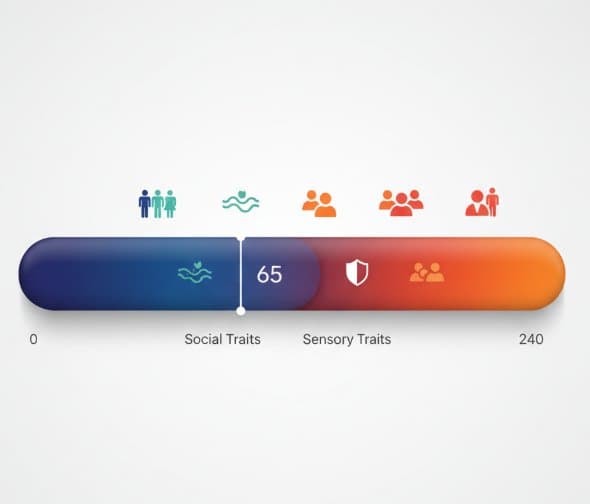
A total score only tells half the story. To truly grasp what is a high RAADS-R score, you must examine the four subscales. Sometimes, a person might have a "moderate" total score but an "extreme" score in one specific category. This nuance explains why two people with the same total can have vastly different daily struggles.
Social relatedness is the most heavily weighted subscale, containing 39 of the 80 questions. It covers how you interact with others, process social cues, and manage friendships. A high score here often means you find small talk exhausting, prefer direct communication, or feel like you are following a manual that everyone else already memorized.
These subscales look at how your body interacts with the environment. Do loud noises feel physically painful? Do you become so absorbed in a topic that hours pass like minutes?
When analyzing what is a high RAADS-R score, look for "spikes" in these categories. A high sensory score combined with a high social score is a very strong indicator of neurodivergent processing.
Statistics and ranges are helpful, but they can feel a bit cold. After discovering what is a high RAADS-R score, many people feel a mix of relief and confusion. You might think, "Okay, I have a high score, but how does this help me on Tuesday morning when I'm overwhelmed at work?" The real value of these results lies in pattern recognition rather than just the number itself.
A single number cannot capture your creativity, your empathy, or your resilience. It is a snapshot of your traits, not a summary of your worth. Some people score high because of sensory issues, while others score high because of their deep, logical processing styles. Understanding your specific "shape" on the spectrum is more empowering than simply knowing your total.
To help you move from a raw number to a meaningful self-map, you can explore our RAADS-R results explained section. We use AI-enhanced insights to help you visualize how your social, sensory, and cognitive traits intersect. This educational tool is designed for self-reflection, helping you turn data into a clearer picture of your inner world.
It is important to address the question: "How accurate is this?" When discussing what is a high RAADS-R score, we must acknowledge the factors that can influence the outcome. The RAADS-R is a highly respected screening tool, but it is not a clinical diagnosis. Various internal and external factors can shift your results.
"Masking" is the conscious or subconscious act of suppressing your natural traits to fit in. For many adults, especially women and non-binary individuals, masking becomes a survival mechanism. If you are an expert at masking, you might actually score lower than you should because you have spent years convinced that your struggles are "normal." Conversely, as you begin to unmask and realize how much effort you have been exerting, your score might seem higher than you expected.
While the RAADS-R is designed to distinguish autism from other conditions, overlap exists. Certain mental health experiences can mimic some indicators of the spectrum. Consider the following checklist when reflecting on your results:
If you are wondering what is a high RAADS-R score and whether your score is "valid," remember that these results are meant to spark a conversation with yourself or a professional, not to provide a final label.

We must maintain a clear boundary between self-screening and medical assessment. Finding out what is a high RAADS-R score is a powerful moment of self-validation. However, a screening tool is like a compass; it points you in a direction, but it isn't the destination itself.
A clinical diagnosis involves hours of interviews, developmental history checks, and observation by a specialist. A high score on a self-report scale means you identify with the traits, which is a significant and life-changing realization. It allows you to seek better accommodations, join supportive communities, and practice self-compassion.
If your high score brings up intense emotions or if you need formal accommodations for work or school, consulting a neuro-affirming professional is a great next step. They can help you integrate your what is a high RAADS-R score findings into a broader life plan. Whether or not you choose to get a formal diagnosis, your self-knowledge is valid and belongs to you.
You started this search by asking what is a high RAADS-R score, but where you go from here is up to you. For many, a high score is the "permission slip" they didn't know they needed to stop being so hard on themselves. It explains why the world feels so loud, why social interactions are so taxing, and why your passions are so intense.
Key Takeaways for Your Reflection:
If you find yourself frequently checking your results against others, you might want to check your traits with this RAADS-R test again after a few days of reflection. Sometimes, allowing the information to sink in helps you answer the questions more authentically.
Yes, scores in the 110-120 range are very common among autistic adults. While not a diagnosis, these scores suggest that your cognitive and social patterns align significantly with the spectrum. Understanding what is a high RAADS-R score in this context helps validate your lived experience.
The theoretical maximum is 240. However, it is almost impossible for an individual to score this high, as the test covers a very broad range of potential traits. Most high-scoring neurodivergent adults land between 130 and 170.
Yes, ADHD and autism often share overlapping traits, such as sensory sensitivity and hyper-focus. While the RAADS-R is specifically designed to identify autistic traits, having ADHD can contribute to a higher score, especially in the sensory and interest categories.
Masking can lead to a lower score if you have spent years "training" yourself to act neurotypical. As you learn more about what is a high RAADS-R score and begin to unmask, you may find that you relate to the questions more honestly, potentially leading to a higher, more accurate result.
Not necessarily. Many adults find that a high score provides enough self-validation to improve their lives. A formal diagnosis is usually necessary only if you require legal accommodations, specific medical support, or if you personally need that level of external confirmation.