//

You just took the test or heard about it online. Now, you are probably wondering what your results actually mean. Finding the exact average raads-r score for neurotypical adults is the best way to make sense of your personal traits. It is completely normal to feel a bit confused or overwhelmed by a single number.
However, understanding this baseline gives you a clear starting point for self-discovery. This article will reveal the exact neurotypical averages and provide a clear visual chart. We will also explore how to safely interpret your results without jumping to clinical conclusions. If you are curious right now, you can confidently explore our comprehensive RAADS-R test online to map your unique baseline.
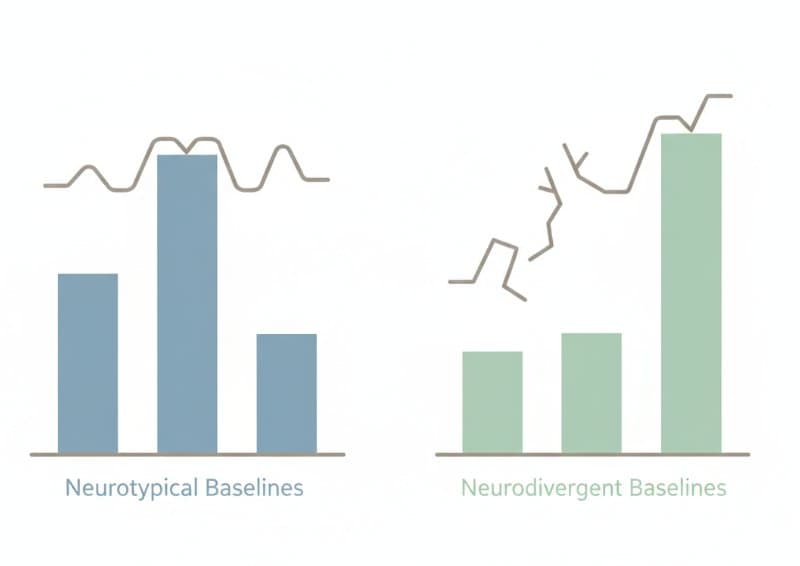
Understanding the average raads-r score for neurotypical individuals is the first step in decoding your test results. People often assume that a neurotypical person will score a perfect zero. However, this is rarely the case. Human behavior is complex, and everyone experiences mild sensory or social quirks from time to time.
Research provides a very clear window into neurotypical scoring patterns. The exact average raads-r score for neurotypical adults typically falls between 25 and 34 points. Therefore, scoring in the 20s or 30s is considered a standard neurotypical baseline.
Why isn't the average zero? Because the test measures human experiences. For example, almost everyone occasionally prefers to be alone. Similarly, many people feel annoyed by certain loud noises. As a result, accumulating a few points across the 80 questions is completely expected. If your score is around 30, it strongly suggests your behavioral patterns align with the neurotypical population.
To truly grasp the average raads-r score for neurotypical individuals, you must compare it to neurodivergent scores. This contrast highlights how the test separates general personality quirks from distinct autistic traits.
In clinical studies, autistic adults consistently score much higher. In fact, the average score for diagnosed autistic adults usually lands above 130. This creates a massive gap between the neurotypical average of 30 and the neurodivergent average of 130+. Ultimately, this wide gap is what makes the RAADS-R a highly reliable tool for self-reflection. It shows that autistic traits are usually experienced at a much higher intensity and frequency.
Numbers can be confusing without context. Therefore, viewing a raads-r test score chart is the easiest way to see exactly where you stand. This section breaks down the entire raads score range so you can map your personal results safely.
This visual guide categorizes the overall raads score range. You can use this chart as an educational reference to understand different scoring tiers.
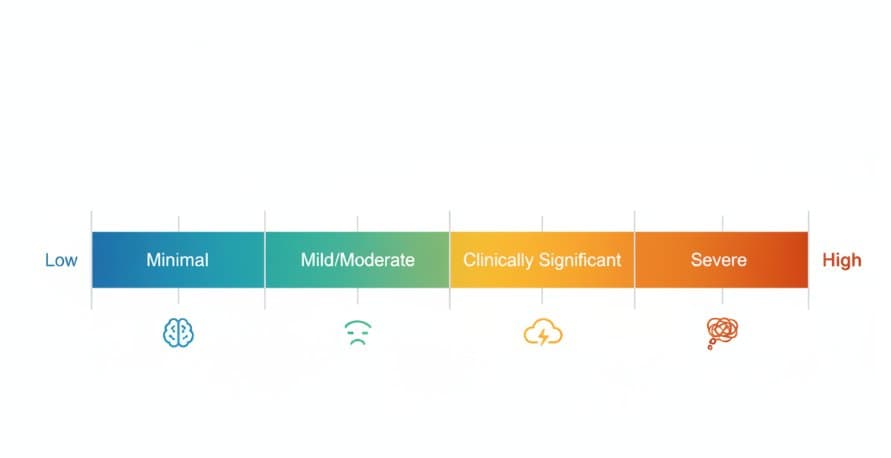
You might notice that 65 points is a critical marker in the raads score range. Clinicians traditionally consider 65 as the "cutoff threshold." If you score 65 or higher, the test suggests you hold a significant number of autistic traits.
However, a score of 66 does not mean you are instantly diagnosed. It simply means your traits have crossed the line from "typical quirks" to "notable patterns." Therefore, the 65-point mark is best viewed as a gentle invitation. It is a prompt to reflect deeper on your mental health and behavioral history.
A single total score never tells the whole story. To fully understand your baseline, you must learn how to score raads-r effectively. The test is not a random collection of questions. Instead, it carefully divides your responses into four distinct clinical categories.
When you explore how to score raads-r, you will find four subscales. Each subscale targets a specific area of your daily experience.
Among the four dimensions, the raads-r social relatedness score often causes the most confusion. This specific subscale holds a lot of weight in the overall test. It measures your internal experience of socializing, not just your outward skills.
For example, you might be excellent at attending parties and making small talk. However, if doing so leaves you physically exhausted for days, your raads-r social relatedness score will reflect that hidden struggle. A high score here often indicates that you are working incredibly hard to fit into typical social molds. Understanding this specific subscale helps validate the invisible effort you put into relationships every single day.
Proper raads-r score interpretation becomes tricky when your results land in the middle. If you score around 70 or 80, you are above the neurotypical average but below the typical autistic average. This gray area requires careful, empathetic analysis.
Imagine you take the test and receive a 74. You are above the 65-point cutoff. Naturally, you might feel anxious or confused. Does this mean you are autistic? Not necessarily.
A score of 74 is a classic borderline scenario. In this case, your raads-r score interpretation requires looking at your subscales. Perhaps your social score is very low, but your sensory score is extremely high because you are sensitive to noise. This means you have a "spiky" trait profile. You hold specific neurodivergent traits, but they might not encompass the entire spectrum. It is an invitation to accommodate your sensory needs rather than a label.
Sometimes, the average raads-r score for neurotypical adults hides a different reality. This happens because of "masking." Masking is the exhausting process of hiding your true traits to blend in with society.
If you have masked your entire life, you might unconsciously answer the test questions based on your "pretend" self. As a result, you might receive a score of 45. You might think you are completely neurotypical. However, deep down, you know you are struggling. If you feel your score is artificially low, you must try taking the test again. This time, answer based on your internal feelings, not your outward performance.
Before you finalize your raads-r score interpretation, you must consider overlapping traits. Other conditions can easily inflate your score, causing a false positive. If you scored between 65 and 90, run through this quick checklist to clarify your results.

If you checked any of these boxes, remember that your score is a reflection of your current distress, not a definitive diagnosis.
Now that you understand the average raads-r score for neurotypical individuals, what comes next? Reading about averages is helpful, but applying this knowledge to your own life is transformative.
Taking action helps reduce the anxiety of an uncertain test result. Follow these clear steps to safely process your baseline score.
Standard tests often just give you a static number. This can leave you with more questions than answers. If you want to truly understand your behavioral patterns, you need detailed insights.
Instead of just guessing what your subscales mean, you can explore ourAI-assisted RAADS-R tool. This educational platform does more than calculate a total. It provides an immediate, personalized breakdown of your unique traits. It helps you safely explore your sensory and social baselines without the pressure of a clinical setting. It is designed purely for self-reflection, offering clarity when you need it most.
Ultimately, knowing the average raads-r score for neurotypical adults is just the first step. Whether you scored a 30, a 74, or a 150, that number is simply a tool for self-education. It is not a rigid box, and it certainly does not define your worth.
Use this information to build a life that respects your boundaries and sensory needs. If you are ready to dig deeper into your unique profile, try to check your traits with thiscomprehensive RAADS-R online guide.
Disclaimer: The tools and information discussed in this article are for educational and self-reflection purposes only. They are not a substitute for professional medical advice, diagnosis, or treatment. If your score suggests high autistic traits and causes you distress, we strongly encourage consulting a qualified healthcare professional.
Does a high RAADS-R score serve as a clinical autism diagnosis? No, a high score does not serve as a clinical diagnosis. The test is a highly effective self-screening tool, but it cannot replace a professional medical evaluation. It simply suggests that you share many behavioral patterns with the autistic community.
Can ADHD or anxiety cause a high RAADS-R score? Yes, absolutely. ADHD, social anxiety, and depression share many overlapping traits with autism. For example, anxiety can mimic social struggles, while ADHD can mimic sensory overload. This overlap can sometimes push a neurotypical score above the 65-point threshold.
What should I do if my score is higher than the neurotypical average? First, do not panic. Use the score as a guide to understand your needs. Start by accommodating your sensory or social limits in your daily routine. If these traits are causing significant stress or disrupting your life, consider reaching out to a therapist who specializes in neurodiversity.
Are there gender differences in average neurotypical RAADS-R scores? Historically, societal expectations force women to "mask" their traits much more heavily than men. Because of this intense masking, women sometimes report slightly lower scores initially, even if their internal struggles are very high.
Can childhood memories impact the accuracy of adult RAADS-R scores? Yes. The test specifically requires you to evaluate your behaviors both "now" and "before age 16." Autism is a developmental condition. Therefore, if you cannot accurately recall your childhood, it might artificially alter your final adult score.